Frequently Asked Questions

Find answers to common questions about grid reliability, energy systems, and how the Canadian Energy Reliability Council works to keep Canada’s energy secure and affordable.

Frequently Asked Questions

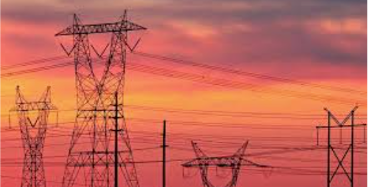
Line losses are the amount of electricity that is lost as it is transmitted along a wire.

As electricity travels down a wire, some of the electrical energy is converted to heat due to the resistance of the wire and is lost. The amount of electricity lost is directly proportional to the square of the amount of current.

The relationship between voltage, current and the total amount of electrical energy is:

P = V * I

Where P = total electrical power which is the amount of electrical energy in a given time period, V= voltage and I =current. From this formula you can see that the higher the voltage is, the less the current needed to deliver the same amount of power.

Given this relationship and the fact that the larger the current the larger the line losses, engineers try to ensure that when transporting electricity over long distances the current is low. To transport the same amount of electric power at that lower current requires them to raise the voltage.

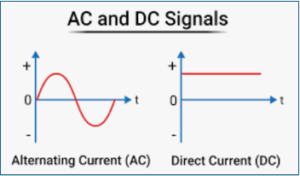
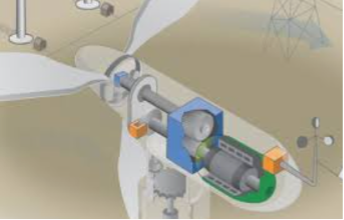
Wind turbines can produce either AC or DC, but most modern grid-connected wind turbines use a variable-speed generator that produces variable-frequency AC, which is then converted to DC, and finally back to grid-quality AC by an inverter (see Question 14). This process is why you often hear that “wind turbines produce DC” — it’s a simplification of a more complex system.

For a generator to deliver AC power directly to the grid, its rotational speed must match the frequency of the grid. As we saw in the previous question, grid-connected turbines and hydroelectric generators rotate at a specific, constant speed —to synchronize with the grid frequency.

However, wind speed constantly changes. To capture the maximum energy from varying wind, wind turbines are designed to change their rotor speed — unlike traditional generators (like gas or hydro), which rotate at a fixed speed. This presents a challenge connecting to the grid directly, hence the conversion to DC than back to grid quality AC.

Although they aren’t turbines., solar photovoltaics and battery electric storage devices also produce DC and are connected to the grid through an inverter (see Question 14).

By controlling the rotational speed of the turbine and ensuring the design of the turbine and generator are suitable, the generator produces electricity at a frequency that matches the frequency the grid, which is operated at:120 volts and 60 Hz in North America and 240 volts and 50 Hz in most of Europe, Asia and Africa. [1]

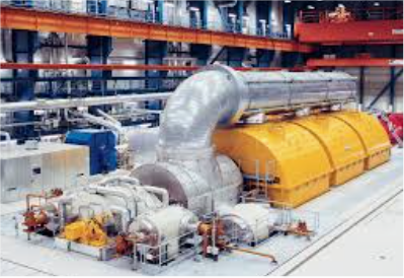
Generators that maintain a constant electrical frequency that is synchronized with the power grid are called synchronous generators because they rotate at a fixed speed directly tied to the grid’s frequency.

Maintaining a constant grid frequency is an important task for grid operators and synchronous generators are important to achieving that goal.

Footnote:

[1] 60 Hz (or more formally 60 Hertz) means that the voltage and the current go through 60 complete cycles – from 0 through the negative maximum, back through zero and the positive maximum and back to zero again – every minute.

Inertia in the power grid refers to the physical resistance to sudden changes in frequency and is provided by the rotating mass of large, synchronous generators.[1] This inertia is sometimes referred to as mechanical inertia.

Large synchronous generators rely on the kinetic energy stored in their spinning masses to provide the inertia. If grid frequency drops suddenly (e.g., due to a generator failure), the inertia from these spinning machines can temporarily supply energy, thereby buying time for other systems (like fast-ramping generators or batteries) to respond.

As power systems transition to renewables (wind, solar), traditional rotating generators are being replaced by inverter-based resources, which do not inherently provide inertia. The impacts of this trend are:

Faster frequency drops when unexpected events occur
Greater risk of blackouts
Need for synthetic or “virtual” inertia

Synthetic inertia is provided when an inverter- detects a change in grid frequency. Its control software rapidly reacts to slow the rate of frequency change, just like real inertia would. It typically responds within 100–200 milliseconds – faster than traditional thermal generators.

However, while virtual inertia mimics inertial response, it does not physically store rotational kinetic energy, so it cannot fully emulate the stabilizing characteristics of synchronous machines in every situation. Further it requires advanced inverter control algorithms and tuning to avoid instability or interaction with other grid resources. Poorly tuned virtual inertia can exacerbate rather than solve an under or over frequency event.

Footnote:

[1] For a discussion of synchronous generators please see the question: What kind of electricity do generators connected to the grid produce?

TypeDispatchable?Notes
Natural Gas (CCGT, OCGT)YesFast ramping, commonly used for peaking or balancing
HydroelectricYesHighly dispatchable if reservoir-based
CoalYesSlower to ramp, but controllable
NuclearPartiallyTechnically dispatchable, but often run at constant output for economic reasons (see Question 9)
Diesel GeneratorsYesUsed in remote or emergency situations
Battery StorageYesExtremely fast response; not “generation” in the traditional sense but functionally similar
Reactor Type / CountryTypical Ramping Rate
Conventional PWR/BWR (e.g., U.S.)~1–5% of capacity per minute (slow)
French PWRs (Load-following capable)~5%/min, up to 80% → 20% in 30 minutes
CANDU (Canada)Historically baseload, some limited ramping
Modern SMRs (e.g., NuScale)Designed for flexibility; 5–10%/min potential
German/Swiss PWRsAlso capable of ~5%/min in some cases

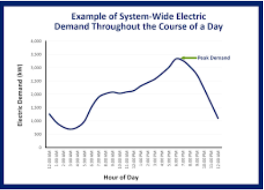
It is important to recognize that we can’t look only at the overall amount of electricity that is required to meet customer demand. We must also consider when that electricity is needed – it is the morning and/or evening peaks that determine how much and what type of generation we need available, even though those peaks may only last for a relatively small proportion of the whole day.

This is analogous to the considerations around building transportation infrastructure. A six-lane freeway with three lanes each way that connects a distant suburb to the downtown core may only have three of its six lanes utilized for a few hours a day, either in the morning or the afternoon, depending upon which side of the road you look at. During off peak hours, two or even one lane each way may suffice.

Looking more closely at the intra-day demand, it is different for every day of the year. In Canada, most utilities historically experienced their largest peaks in the winter, although with the increased use of air conditioning, summer peaks have been increasing for some time.

Ontario’s summer peak exceeded its winter peak almost 20 years ago. The summer (and all-time) peak for Ontario’s electricity demand was set on August 1, 2006, at 27,005 MW. The all-time highest winter peak demand was 24,979 MW, set on December 20, 2004.[1]

Why does the peak load matter? Like freeways, electricity systems must be designed to meet not just the average load but also the peak.

Footnote:

[1] https://www.ieso.ca/Learn/Electricity-Facts-and-Tools/Electricity-Facts?utm_source=chatgpt.com

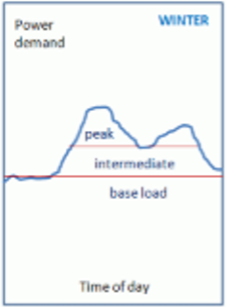
Baseload refers to the minimum level of continuous electricity demand on the grid over a 24-hour period.

The graph to the left illustrates the demand for electricity on a typical winter day. There is a peak in the morning, when people are getting up, probably turning on lights and preparing breakfast, then a similar peak in the evening.

Electricity to meet baseload demand has historically been provided by coal, nuclear, large reservoir hydro and, to a much lesser extent, natural gas. While these resources are the most economic and reliable to provide baseload power, they are not necessarily the fastest ramping (see Question 8) – and don’t need to be in their role as baseload power providers.

The answer to this question is nuanced. Baseload power requires a fully dispatchable generation resource. A single intermittent renewable generation resource cannot provide baseload power because it isn’t dispatchable – it can’t be relied upon to be “always on”. The same is true for a group of intermittent generation resources, such as a wind farm. However, the more geographically dispersed the intermittent generation resources are, the more likely that at least part of the group will be producing even if others aren’t. It is likely that the geographic dispersion needed of wind is less than required of solar.

Connecting a geographically-disperse collection of intermittent generation resources will require additional transmission. Further, the amount of baseload power that such a collection may be able to provide will be less than the sum of the rated capacity[1] of each of the individual resources.

That said, in this sense, intermittent renewables can provide some baseload power, although there is always a risk that the sun won’t be shining or the wind blowing in any of the geographic footprint.

Perhaps because of this, some grid planners and analysts are moving away from the term “baseload” in favor of a more flexible mix:

Dispatchable generation (e.g. gas, hydro)
Variable renewable energy (e.g. wind, solar)
Storage and demand response[2]

Footnotes:

[1] The maximum output a generator, power plant, or energy asset is designed to produce under ideal conditions, as specified by the manufacturer.

[2] A grid management strategy where electricity consumers are incented to reduce or shift their electricity use during periods of high demand

Spinning reserve is backup generating capacity that is:

Online (already synchronized with the grid),
Running at less than full load, and
Able to ramp up power output quickly (typically within seconds to a few minutes)

It is used to maintain grid reliability in case of a sudden generator, transmission or other failure or a large, unexpected increase in demand.

Technologies that providing spinning reserve include:

Gas turbines
Hydroelectric units
Diesel generators
Battery energy storage (for fast frequency response — not traditional spinning, but now accepted in some cases)

  • Ride-through: This refers to the ability of a generator to remain connected to the grid in the face of voltage or frequency fluctuations. Typically synchronous generators will ride through such fluctuations. However, many inverters will disconnect from the grid in these circumstances.
  • Grid following is an inverter based resource that synchronizes to the voltage and frequency of the existing electrical grid, rather than setting them. It is dependent on a live grid signal to operate. Am inverter based resource that doesn’t need a signal from the grid to operate in considered grid forming.
  • Grid-forming capability is essential to maintain stability is especially critical for the following situations:
    • Isolated systems (islands, microgrids).
    • Low-inertia grids (grids with high intermittent renewable penetration) (See Question 7)) .
    • Black start recovery of the grid after a major outage.
  • inverter based resource would be uanable to
  • Black Start (see Question 15). This is the ability of a generator, in the event of a grid shutdown, to restart the grid.
  • Potential back door vulnerabilities. Inverters almost all have some form of remote connectivity to enable remote control by legitimate owners and operators. Depending on where they are physically, a cellular network connection might be the only practical way to connect to them. Therefore, many inverters are vulnerable to malicious actors attempting unauthorized entry.
  • Generation
    • Rooftop solar PV
    • Small wind turbines
    • Micro-hydro units
    • Natural gas microturbines
  • Storage
    • Residential or commercial battery systems
    • Electric vehicle batteries (when used for grid services)
    • Thermal storage (ice storage for cooling)
  • Flexible Loads
    • Smart appliances that can adjust demand
    • Electric vehicle charging that can be scheduled or curtailed
  • Coordination: Large numbers of DERs require advanced control systems like Virtual Power Plants (VPPs) (see Question 16).
  • Grid Impact: High penetration can cause voltage fluctuations, reverse power flows, or protection coordination issues.
  • Regulation & Market Access: Many markets are still updating rules to allow DERs to participate in wholesale markets, which typically only operate on the transmission system.
  • In Germany and the UK, Statkraft manages a VPP aggregating over 1,000 renewable energy sources, with a combined capacity exceeding 10 GW.
  • In Australia, Tesla’s South Australian VPP has approximately 35 MW of capacity through approximately 7,000 Powerwall installations as of late 2024
  • In Texas, Bandera Electric Cooperative’s VPP (via at-home batteries and solar systems) currently contributes around 25.5 MW and is part of a pilot program aiming to expand up to 80 [iv]
  • During a recent heat dome in the U.S., 75 VPP projects featured 1.5 GW of capacity, serving about 3.9 million enrolled customers; this is still a fraction of the total DOE estimate

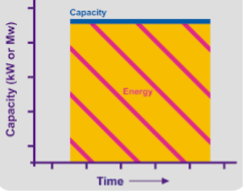
Energy is the total amount of electricity produced, consumed, or stored over a period of time, measured in megawatt-hours (MWh) or kilowatt-hours (kWh).

Capacity is the maximum instantaneous output a generator or storage device can produce or deliver, typically measured in megawatts (MW) or kilowatts (kW).

Capacity is often used to denominate the size of a power plant or battery – it tells you how much power can be delivered at a given moment.

A capacity market is a type of electricity market that ensures there will be enough generating capacity available in the future to meet peak electricity demand — even if that capacity is not used frequently. These markets enable customers to pay power plants (and other resources) to be on standby, so they’re ready when needed.

Capacity markets typically operate years in advance. For example, PJM’s Base Residual Auction is 3 years ahead. This is an attempt to ensure there will be enough capacity to meet peak demand in the future. The longer time scale also enables providers to develop and add capacity which may require construction of new plants or expansion of others.

Sellers commit capacity which may not necessarily produce energy. However, they are paid simply to be ready and do not need to provide any energy in order to be paid.

Want a copy of the FAQs? Click the link and button below